

Kenya is where the word “safari” was born — it simply means “journey” in Swahili — and no country does the African safari with more drama. This is the land of the Masai Mara, where over a million wildebeest thunder across the plains in the Great Migration; of elephants ambling beneath the snows of Kilimanjaro; of lion prides, cheetah sprints and leopards draped in fig trees. And when the dust of the bush settles, the warm Indian Ocean and the palm-lined sands of the coast are waiting.
It is also one of Africa's most rewarding first-timer destinations: the wildlife is spectacular and reliable, the tourism infrastructure is well developed, English is widely spoken, and you can combine genuine wilderness with rich Maasai and Swahili cultures. This guide covers everything you need to plan a smooth, safe and unforgettable Kenyan adventure — the new eTA rules, when to go, what it really costs in 2026, a ready-made itinerary and the practical know-how that makes all the difference.
Why visit Kenya?
- The Great Migration. The Masai Mara hosts the climax of the world's greatest wildlife spectacle, when wildebeest and zebra brave crocodile-filled rivers (roughly July–October).
- Big Five and big cats. Kenya offers some of the most reliable lion, leopard, elephant, buffalo and rhino viewing anywhere, plus exceptional cheetah sightings.
- Iconic landscapes. Elephants framed by Kilimanjaro in Amboseli, flamingo-pink lakes in the Rift Valley, and the red-earth wilderness of Samburu.
- Beaches to finish on. Diani, Watamu and the old Swahili island of Lamu offer powder-white sand and turquoise water — the perfect post-safari wind-down.
- Living culture. Visiting a Maasai community and exploring Swahili coastal towns add real depth beyond the wildlife.
It suits safari first-timers, couples, photographers, families (kid-friendly lodges abound) and anyone wanting a bucket-list wildlife trip with a beach reward at the end.
Best time to visit Kenya
Kenya is a year-round destination, but timing changes both the wildlife and the price. The country sits on the equator, so it doesn't have hot and cold seasons so much as dry and wet ones.
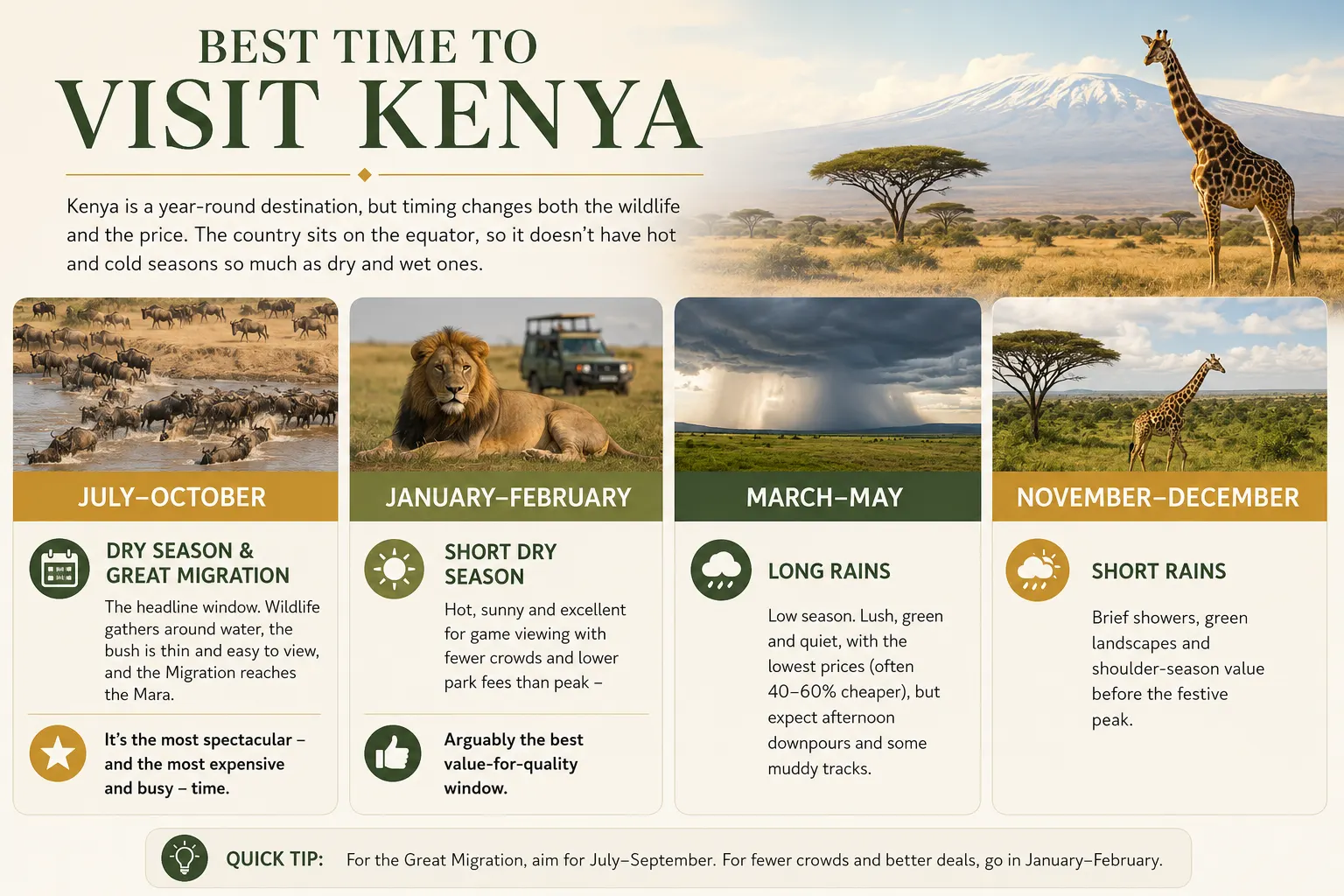
- July–October (dry season & Great Migration): The headline window. Wildlife gathers around water, the bush is thin and easy to view, and the Migration reaches the Mara. It's the most spectacular — and the most expensive and busy — time.
- January–February (short dry season): Hot, sunny and excellent for game viewing with fewer crowds and lower park fees than peak — arguably the best value-for-quality window.
- March–May (long rains): Low season. Lush, green and quiet, with the lowest prices (often 40–60% cheaper), but expect afternoon downpours and some muddy tracks.
- November–December (short rains): Brief showers, green landscapes and shoulder-season value before the festive peak.
Visa & entry requirements: the eTA
Kenya scrapped traditional visas and visa-on-arrival in January 2024. Almost every foreign visitor now needs an Electronic Travel Authorisation (eTA) approved before they fly.
- Who needs it: Nearly all non-African travellers — including US, UK, EU, Canadian and Australian citizens — plus every child and infant (each person needs their own).
- Cost & where: Around US$30, applied for online at the official portal etakenya.go.ke. Avoid third-party sites that add fees.
- Timing: Apply at least 3 days ahead (ideally a week). It's typically approved within 48–72 hours. There is no visa on arrival — without an approved eTA you can be denied boarding.
- Validity: Standard tourist stay is up to 90 days. A multiple-entry eTA option exists for frequent visitors.
- Regional travel: The East Africa Tourist Visa (US$100) covers Kenya, Uganda and Rwanda — ideal if you're combining countries.
Getting there & getting around
Most visitors fly into Jomo Kenyatta International Airport in Nairobi (some coastal trips use Moi International in Mombasa). Inside the country:
- Light aircraft: The classic way to reach the parks — short scheduled flights from Nairobi's Wilson Airport drop you at bush airstrips near the Mara, Amboseli and beyond, saving long drives.
- Safari vehicles: Game drives use 4x4 Land Cruisers or pop-top safari minibuses with a driver-guide; you don't self-drive in the reserves.
- SGR train: The modern Madaraka Express links Nairobi and Mombasa comfortably in around five hours — a scenic, good-value way to reach the coast.
- Within Nairobi: Use ride-hailing apps (Uber/Bolt) or trusted hotel transfers.
- Skip: Matatus (shared minibuses) are cheap but crowded and have a poor safety record — not recommended for visitors between towns.
Where to go: Kenya's top parks & regions
- Masai Mara: The star — big cats, the Migration and classic golden-grass plains. Private conservancies on its edges offer off-road driving, night drives and fewer vehicles.
- Amboseli: Huge elephant herds with Mount Kilimanjaro as a backdrop — Kenya's most photogenic park.
- Lake Nakuru: A Rift Valley lake famous for flamingos and rhinos, easy to combine with the Mara.
- Samburu: Rugged northern reserve with species you won't see down south (Grevy's zebra, reticulated giraffe, gerenuk).
- Tsavo East & West: Vast, wild and less crowded, known for “red” dust-covered elephants.
- The coast (Diani, Watamu, Lamu): White-sand beaches, coral reefs and centuries-old Swahili culture — the ideal way to end a trip.
- Nairobi: Don't rush through — the Sheldrick Elephant Orphanage, Giraffe Centre and Nairobi National Park (wildlife with a city skyline) are all worth a day.
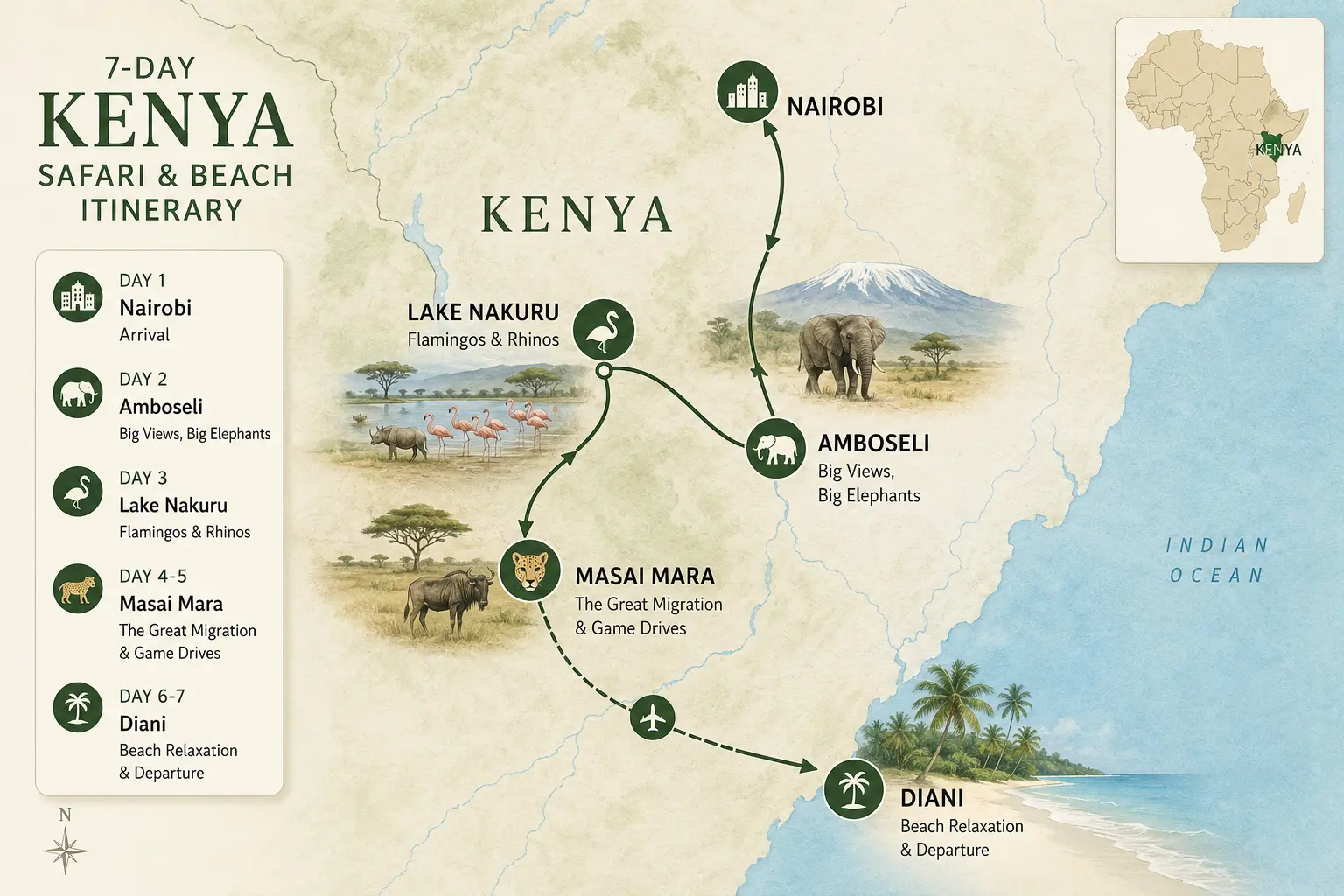
The perfect 7–10 day Kenya itinerary
This route blends Kenya's best wildlife with a coastal finish. Use light aircraft for the long hops to maximise game-viewing time.
Day 1 — Nairobi
Arrive and settle in. Visit the Sheldrick Elephant Orphanage and Giraffe Centre, then enjoy a Kenyan dinner. An easy, low-key start to beat jet lag.
Days 2–3 — Amboseli National Park
Fly or drive south for elephants beneath Kilimanjaro. Two nights gives you sunrise and sunset drives with the mountain in view (clearest early morning).
Days 4–6 — Masai Mara
The heart of the trip. Three nights gives you the best odds of lions, cheetahs, leopards and — in season — the Migration. Add a sunrise hot-air balloon safari and a visit to a Maasai community.
Days 7–10 — The coast (Diani or Watamu)
Fly to the coast to unwind: white sand, snorkelling or diving on the reef, fresh seafood and Swahili culture. The perfect contrast to the dust of the bush.
How much does a Kenya safari cost? (2026)
Kenya is a premium safari destination, and the biggest single cost driver is park fees — they're unusually high and they jump in peak season. The figures below are per person, land-only (excluding international flights).
| Style | Per person / day | Accommodation | Best for |
|---|---|---|---|
| Budget / camping | $150–300 | Shared vehicle, basic camps | Backpackers, first safari |
| Mid-range | $300–600 | Comfortable tented camps, semi-private 4x4 | Most travellers |
| Luxury (all-in) | $1,000–1,500 | Premier camps, light-aircraft transfers | Special occasions |
| Ultra-luxury | $2,000+ | Exclusive private camps & flying | Bucket-list splurge |
As a rough guide, a 7-day Kenya safari lands somewhere between about $2,600 per person (mid-range) and $7,000+ (luxury), excluding international flights. A short 3-day budget group safari to the Mara can start around $650–1,200 per person.
Food & drink
Kenyan food is hearty and built around grilled meat, maize and fresh coastal flavours. Try:
- Nyama choma — Kenya's beloved grilled meat, the centrepiece of any celebration.
- Ugali — a maize-flour staple eaten with stews and greens (sukuma wiki).
- Pilau & biryani — fragrant spiced rice dishes reflecting the Swahili coast's Arab and Indian heritage.
- Samaki wa kupaka — coastal fish in a rich coconut-and-tamarind sauce.
- Mandazi & chai — lightly sweet fried dough with spiced tea.
- Tusker beer & Kenyan AA coffee — the local lager, and some of the world's finest coffee, grown on the slopes of Mount Kenya.
Is Kenya safe? Safety & practical tips
Kenya is a well-trodden, welcoming destination and the vast majority of visitors have a trouble-free trip. As with any country, you travel sensibly rather than nervously, and the safari areas themselves are very safe.
- In Nairobi and Mombasa, take normal big-city precautions: use ride-hailing apps or hotel transfers at night, don't flash valuables, and keep car doors locked in traffic.
- Check your government's travel advisory before booking — some areas near the Somali border in the north-east, and the far-north coast, are advised against and not on standard tourist routes anyway.
- On safari, always follow your guide and stay in the vehicle unless told otherwise — these are wild animals.
- Use bottled or filtered water, and protect against mosquitoes (long sleeves at dusk, repellent, antimalarials).
- Carry some cash in small notes for tips and markets; M-Pesa mobile money is used everywhere but needs a local number.
What to pack & common mistakes
- Pack neutral colours (khaki, olive, beige) for game drives; avoid bright white and dark blue/black (the latter attracts tsetse flies).
- Bring layers — dawn drives are cold, midday is hot — plus a hat, sunscreen, sunglasses and good binoculars.
- Soft-sided duffel bags are required on light aircraft, which also have strict weight limits — pack light.
- Don't try to cram in too many parks; two or three done well beats a rushed five.
- Don't underestimate park fees when budgeting, and don't forget to apply for your eTA before you fly.
- Don't skip the coast if you have time — it's the perfect end to a safari.
Frequently asked questions
Do I need a visa to visit Kenya?
There are no traditional visas anymore. Nearly all foreign visitors (including US, UK, EU, Canadian and Australian citizens) must apply online for an Electronic Travel Authorisation (eTA), which costs around US$30, before travelling. There is no visa on arrival, so apply at etakenya.go.ke at least a week ahead. Most African nationals are exempt.
When is the best time to see the Great Migration in Kenya?
The dramatic Mara River crossings in the Masai Mara generally take place between July and October, with the peak often around August–September. Exact timing depends on the rains each year, so allow a few flexible days if the Migration is your priority.
How many days do you need for a Kenya safari?
Seven to ten days is ideal, enough to combine two or three parks and a few days on the coast. With limited time, a focused 3–4 day Masai Mara safari still delivers world-class wildlife.
Is Kenya safe for tourists?
Yes — most visitors travel safely. Take normal big-city precautions in Nairobi and Mombasa, follow your guide on safari, and check your government's advisory for specific regions (parts of the north-east near Somalia are best avoided and aren't on tourist routes). Safari areas and main destinations are very safe.
How much does a Kenya safari cost?
Land-only, budget safaris run about $150–300 per person per day, mid-range $300–600, and luxury $1,000–1,500+. High park fees (the Masai Mara alone is $100–200 per day) are a big driver, and prices peak from July to October during the Migration.
Do I need vaccinations or malaria tablets for Kenya?
A yellow fever certificate may be required, especially if arriving from a risk country, and antimalarial medication is recommended for most safari areas (Nairobi's highlands are lower risk). Always get personalised advice from a travel clinic before you go.
Final thoughts
Few trips deliver the sheer wonder of a Kenyan safari — that first lion at dawn, the thunder of the Migration, an elephant herd silhouetted against Kilimanjaro. Sort your eTA early, time your visit to your priorities and budget, give yourself enough nights in the Mara, and finish on the coast if you can. Do that, and Kenya will give you the trip of a lifetime.