
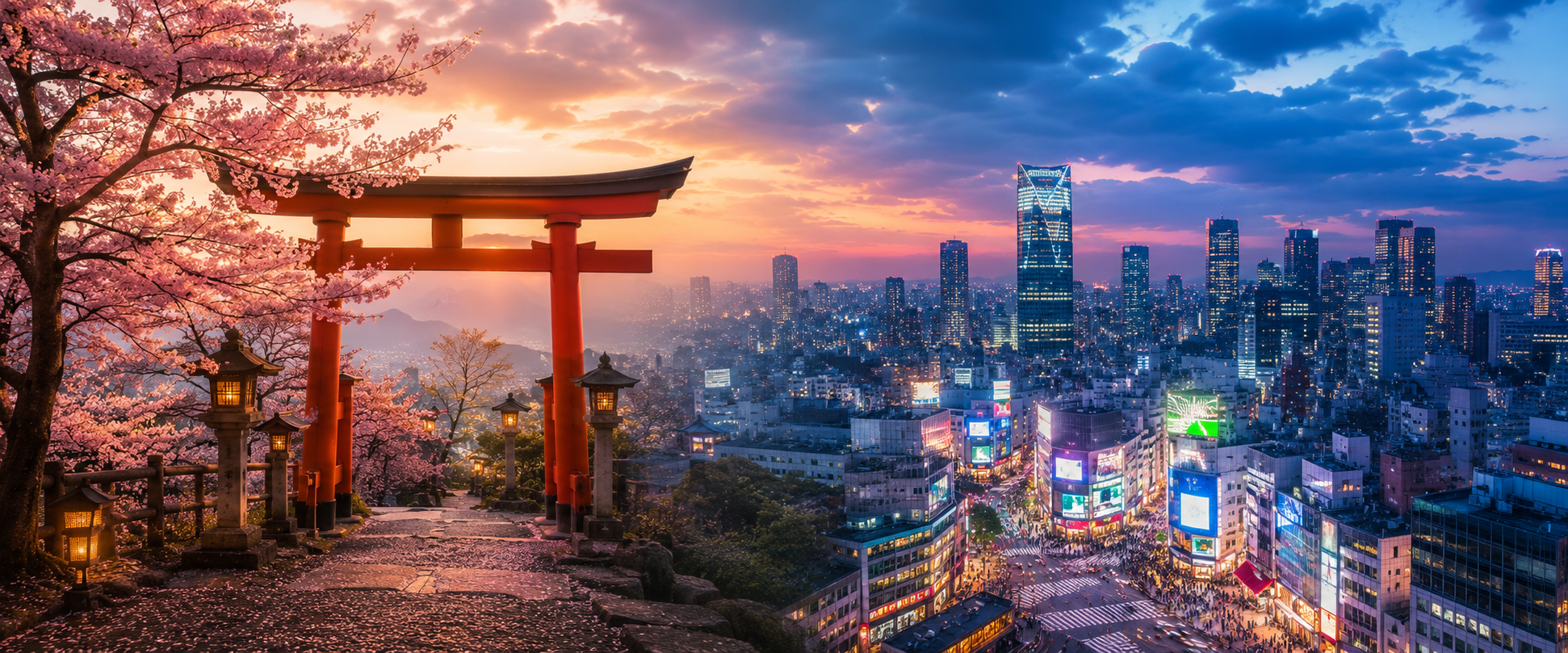
Japan in 2026 is a study in
contrast: centuries-old Shinto shrines sit blocks from robot cafés, bullet
trains slice past snow-dusted temples, and a weak yen has turned what was once
a splurge destination into one of the best-value trips in the world right now.
This Japan travel guide 2026 is built for first-timers who want the real
picture before they book — not just Tokyo and Kyoto, but the food, the
etiquette, the cost, and the cities beyond the obvious two. Whether you're
chasing cherry blossoms in April, powder snow in Hokkaido, or a quieter
alternative to the crowds, this guide walks through everything you need to
build a Japan itinerary that actually fits how you want to travel — and links
out to 22 in-depth guides covering every detail below.
Check👉 10-Day Japan Itinerary for First-Timers (2026)
Is Japan Worth Visiting in 2026?
Short answer: yes, and 2026 is a
genuinely good year to go. Japan is currently enjoying a rare combination — a
weak yen that makes hotels, meals and shopping feel noticeably cheaper for
travellers paying in dollars, euros or pounds, plus a slight dip in visitor
numbers from some source markets that's easing pressure on the most
photographed spots. That means shorter queues at Fushimi Inari, easier
reservations at popular restaurants, and a calmer version of a country that
broke its own tourism records only a year earlier.
Japan suits culture-first
travellers, food obsessives, design and architecture fans, and solo travellers
who want one of the easiest, safest countries in the world to navigate alone.
It's a slightly harder sell for anyone chasing dirt-cheap backpacker prices
(Southeast Asia will always beat it on cost) or a pure beach-and-do-nothing
holiday — Japan rewards curiosity and a bit of structure more than it rewards
flopping by a pool.
Best Time to Visit Japan
Japan's seasons are dramatic and
each one pulls a different kind of traveller. Broadly: spring for cherry
blossoms, autumn for foliage, winter for powder snow and illuminations, and
summer for festivals if you can handle the humidity.
|
Month |
Highlight |
Crowd level |
|
January |
Winter illuminations, New
Year traditions, ski season opens |
Low–moderate |
|
February |
Powder skiing peak in
Hokkaido/Niseko, plum blossoms |
Low |
|
March |
Cherry blossoms begin in the
south (Kyushu, then Kyoto/Tokyo late month) |
Rising fast |
|
April |
Peak cherry blossom in most
of Japan; Golden Week crowds begin late month |
Very high |
|
May |
Fresh greenery, Golden Week
(avoid the first week if possible) |
High, then easing |
|
June |
Rainy season (tsuyu) in most
regions except Hokkaido |
Low |
|
July |
Summer festivals, fireworks,
Mt. Fuji climbing season opens |
Moderate–high |
|
August |
Peak heat and humidity; Obon
holiday domestic travel spike |
High (domestic) |
|
September |
Typhoon season risk; fewer
tourists |
Low |
|
October |
Comfortable temperatures,
early autumn colour in the north |
Moderate |
|
November |
Peak autumn leaves in Kyoto
and Tokyo |
High |
|
December |
Winter illuminations,
quieter temples, ski season starts |
Low–moderate |
Japan Culture & Etiquette Essentials
Japan rewards travellers who
understand a few unwritten rules before they arrive. None of this is
complicated, but getting it right makes the trip feel far smoother.
•
Shrines and temples: a small bow at the gate, quiet
voices, and — at Shinto shrines — the simple ritual of rinsing your hands at
the water basin before approaching.
•
Onsen (hot springs): wash thoroughly at the stall
before entering the bath, never let a towel touch the water, and check tattoo
policies in advance — many public baths still restrict them.
•
Tea ceremony: less about perfect technique, more about
slowing down; most tourist-facing ceremonies will guide you through every step.
•
Everyday manners: shoes off indoors, no eating while
walking in crowded areas, phones on silent ("manner mode") on trains,
and queueing is taken seriously everywhere from train platforms to ramen shops.
Food in Japan — What and Where to Eat
Food is arguably the single
biggest reason people search for Japan, and Tokyo alone holds more Michelin
stars than any other city on earth — but the best meals are often the cheapest
ones. Build your eating plan around regional specialities rather than trying to
eat everything in one city.
•
Tokyo: sushi (from conveyor-belt to counter omakase),
ramen by neighbourhood, izakaya-hopping, and depachika department-store food
halls for high-end grab-and-go.
•
Kyoto: kaiseki multi-course dining, shojin ryori
(Buddhist vegetarian temple food), and matcha everything.
•
Osaka: Japan's self-declared food capital — takoyaki,
okonomiyaki, kushikatsu, and the Dotonbori street-food crawl.
•
Hiroshima: its own distinct layered okonomiyaki style,
plus fresh oysters from the Seto Inland Sea.
• Hokkaido/Sapporo: seafood (uni, crab, scallops straight off the boat), miso ramen, and dairy desserts from the region's famous farmland.
Where to Go — City by City
Tokyo and Kyoto will always
anchor a first trip, but 2026's real trend is travellers pushing further —
second cities like Sapporo have seen search interest climb roughly 45%, more
than double the growth of Tokyo or Osaka, as people look for the same magic
with fewer crowds.
•
Tokyo — the anchor city: Shibuya and Shinjuku energy,
teamLab digital-art museums, Asakusa for traditional streets, and one of the
best public transport networks in the world.
•
Kyoto — the culture pillar: Fushimi Inari's torii
tunnels, the Arashiyama bamboo grove, Gion's geisha district, and hundreds of
temples within walking or bus distance.
•
Osaka — the food and energy gateway: Dotonbori's neon
canal, Osaka Castle, and the easiest base for day trips to Nara and Kobe.
•
Hokkaido/Sapporo — the rising second city: world-class
powder skiing, seafood markets, lavender fields in summer, and noticeably fewer
tourists than the golden route.
•
Hiroshima & Miyajima — the Peace Memorial Park and
Museum, plus the floating torii gate at Itsukushima Shrine, easily combined as
a day trip from Kyoto or Osaka.
Getting Around — Trains and the JR Pass Question
Japan's train network is the
best in the world to travel on and, since 2023, one of the more confusing ones
to budget for. The Japan Rail Pass used to be an automatic purchase for almost
any visitor; since its 2023 price increase to ¥50,000 for seven days, that's no
longer true. A simple Tokyo–Kyoto round trip alone no longer breaks even
against buying individual Shinkansen tickets — the pass only pays off if your
route covers genuine multi-city, long-distance ground, such as a
Tokyo–Kyoto–Osaka–Hiroshima loop with a few extra long-haul legs added in.
The practical takeaway: add up
your planned intercity train routes before you buy anything. If you're staying
mostly in one region, a regional pass (like the JR Kansai Wide Area Pass) or
point-to-point tickets will almost always be cheaper. For city transport, a
rechargeable IC card (Suica or Pasmo) covers subways, buses and
convenience-store payments everywhere.
Is Japan Expensive? Budget Breakdown by Trip Style
Japan's reputation as an
expensive destination is increasingly out of date. The weak yen has quietly
made it one of the better-value developed-world trips available right now —
though costs vary hugely by how you travel.
|
Trip style |
Daily budget
(approx.) |
What's
included |
|
Backpacker |
¥8,000–12,000 (~US$55–80) |
Hostel dorms,
convenience-store and casual meals, local transport, free/cheap sights |
|
Mid-range |
¥18,000–25,000 (~US$120–170) |
3-star hotels or business
hotels, sit-down meals, some paid attractions, regional trains |
|
Comfort |
¥35,000+ (~US$235+) |
Ryokan stays, kaiseki
dinners, Green Car train travel, private tours |
The biggest hidden costs to
budget for: Shinkansen tickets if you skip the JR Pass, entrance fees stacking
up across multiple temples, and — from later in 2026 — a change to how in-store
tax-free shopping works, moving from an instant discount to a refund-on-departure
system.
Sample Itineraries
Three starting frameworks —
adjust the pacing to your energy level and add a second city where noted.
7 days — Tokyo & Kyoto
essentials
4 nights Tokyo (Shibuya,
Asakusa, a teamLab visit, one day trip to Hakone or Nikko) → Shinkansen to
Kyoto for 3 nights (Fushimi Inari, Arashiyama, Gion).
10 days — the golden route
4 nights Tokyo → 4 nights Kyoto
(with a day trip to Nara) → 2 nights Osaka for the food scene, flying home from
Kansai Airport.
14 days — golden route plus a
second city
The 10-day route above, extended
with 3–4 nights in Hiroshima/Miyajima or Hokkaido/Sapporo — this is also the
itinerary length where the JR Pass math starts to genuinely work in your
favour.
Is Japan Safe? Solo, Family and First-Timer Notes
Japan consistently ranks among
the safest countries in the world to travel, and that holds true in 2026.
Violent crime against tourists is rare, public transport runs on time and is
safe to use late at night, and it's one of the most straightforward countries
in the world for solo and solo female travellers specifically — a trend
reflected in search data, where interest in solo trips to Japan keeps climbing.
The practical risks worth
knowing about are less about crime and more about logistics: earthquakes are
common but rarely felt strongly in cities, typhoon season (roughly
August–October) can disrupt travel plans with little warning, and language
barriers outside major cities are real, though translation apps close the gap
easily. Families will find Japan unusually easy too — clean public facilities,
low crime, and a culture that's generally welcoming to children in restaurants
and on trains.
Frequently Asked Questions
Do I need a visa to visit Japan
in 2026?
Travellers from many countries,
including the US, UK, EU and Australia, can enter Japan visa-free for short
tourist stays (typically up to 90 days). Requirements vary by nationality, so
check current rules before booking flights.
What's the best app for getting
around Japan?
Google Maps handles train times
and platform numbers accurately across Japan. Pair it with a transit IC card
(Suica or Pasmo, both now available as phone wallets) and a translation app
like Google Translate with the camera feature for menus and signs.
Is tipping customary in Japan?
No — tipping isn't expected and
can even cause confusion in restaurants, taxis or hotels. Excellent service is
simply the standard, not something that requires an extra payment.
Will I struggle with the
language barrier?
Less than most first-timers
expect. Major cities have English signage on trains and in stations, many
restaurants have picture menus or plastic food displays, and translation apps
cover almost everything else.
What should I pack for Japan?
Pack for the season above all
else — layers for spring/autumn, breathable fabrics for summer humidity, and
proper warmth for winter in the north. A portable charger, a compact umbrella,
and shoes that are easy to slip on and off (for temples, ryokan and some
restaurants) are worth prioritising year-round.
Tokyo vs Kyoto vs Osaka vs Sapporo — At a Glance
|
City |
Vibe |
Best for |
Ideal days |
|
Tokyo |
Fast-paced, futuristic,
endless neighborhoods |
First-time energy, shopping,
food variety |
3–5 |
|
Kyoto |
Slow, traditional,
temple-dense |
Culture, photography, geisha
district |
3–4 |
|
Osaka |
Loud, food-obsessed,
friendly |
Street food, nightlife,
day-trip base |
2–3 |
|
Sapporo |
Spacious, seasonal,
uncrowded |
Powder skiing, seafood,
second-city travel |
3–4 |